
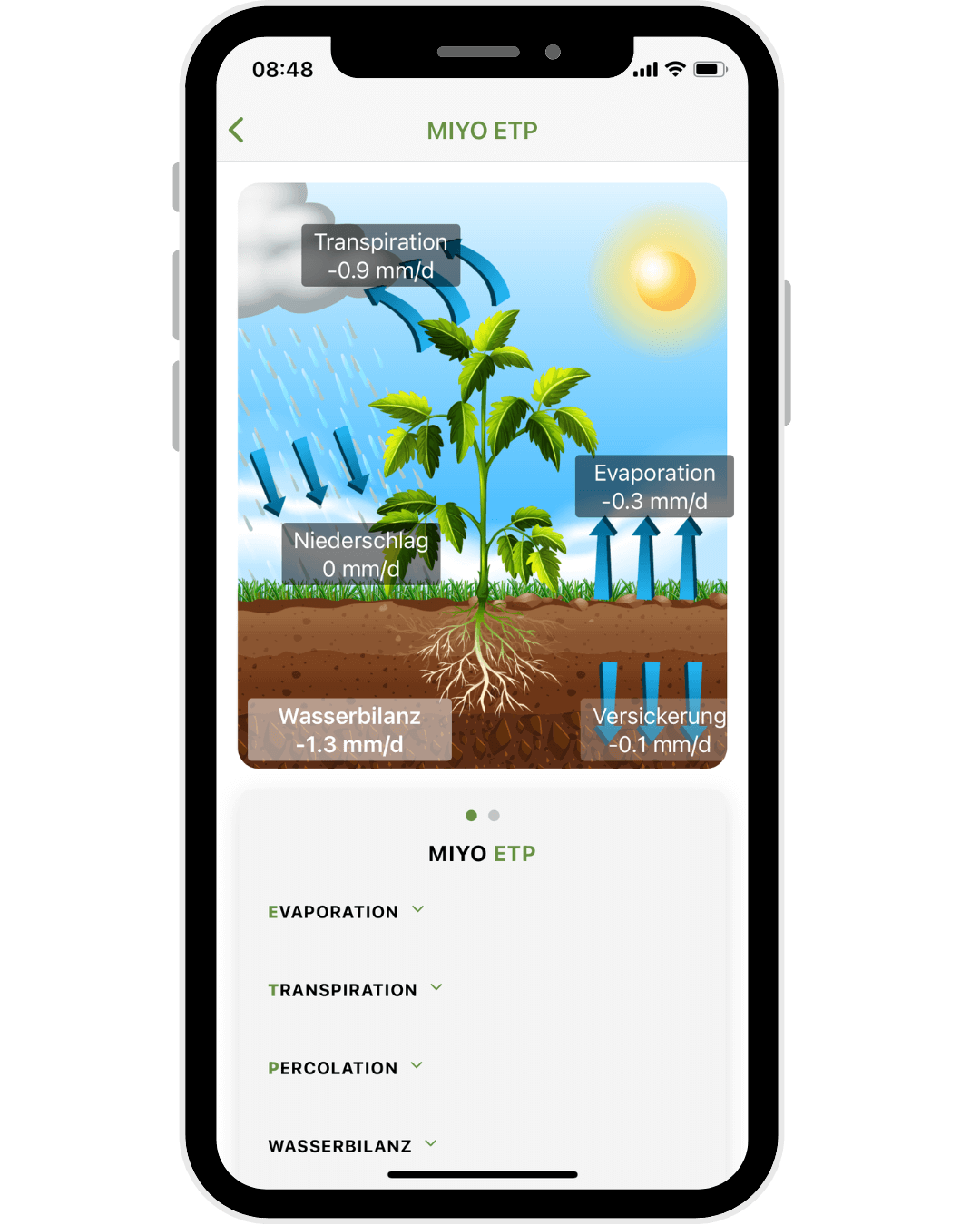
From now on, MIYO calculates evapotranspiration and offers another option for irrigation control.
🌱💧 What is evapotranspiration? 💧🌱
Evapotranspiration describes the water cycle in the soil in and out of the root zone, which in gardens includes about the top 20 cm of soil layer. This cycle is determined by several processes. 🌍
👉 Precipitation: The most important source of water supply.
👉 Evaporation: The evaporation of water at the soil surface.
👉 Transpiration: The loss of water through the leaves of plants.
👉 Percolation (infiltration): Water penetrates the soil and moves from the upper soil layers (root zone) to deeper layers. This is crucial to replenish groundwater reserves. Too little infiltration due to soil compaction and sealing? Then precipitation runs off on the surface and is not available for plants or groundwater recharge.
The right balance of these processes is essential for healthy plant growth, stable ecosystems, and the fight against climate change.
Evaporation
Factors influencing evaporation (in parentheses the approximate share of the factor in total evaporation. Since the factors influence each other alternately, the exact share depends on the overall situation):
-
🌡️ Temperature (~30–40%): Higher temperatures increase evaporation.
- 🌞 Sunlight intensity/cloudiness (~30–50%): strong sunlight increases evaporation.
- Wind speed (~20–30%): increases the release of water into the air.
- 💧 Humidity (~10–25%): dry air absorbs water more easily.
-
Soil cover (~5–15%): open soils evaporate more than those covered with vegetation.
Transpiration:
Transpiration in plants occurs through the open stomata (leaf pores) and fulfills several vital functions that go far beyond compensating for water loss:
-
Cooling: heat energy is released
-
Nutrient transport: water conduction function through the negative pressure created by transpiration. This allows dissolved minerals from the soil to travel from the roots to the leaves.
-
Stabilization of cell pressure, which is important for the stability of the plants.
-
Photosynthesis: water is released at the stomata, but CO2 is also absorbed.
Factors influencing transpiration:
The factors influencing transpiration are similar to those for evaporation, mainly sunlight intensity, temperature, wind, as well as air and soil moisture. Additionally, a very important factor is the plant species, as each plant is differently adapted to heat and drought.
Heat-resistant plants generally have small, often thick or hairy leaves and deep roots. Examples include many herbs such as lavender, rosemary, sage, thyme, as well as yarrow and stonecrop.
In contrast, many vegetable varieties show high transpiration values. For example, tomato, zucchini, pumpkin. Most types of lawn transpire a lot, but so do hydrangeas with their many large leaves.
The MIYO calculation of evapotranspiration
The MIYO calculation of evapotranspiration is based on the Penman-Monteith model, which is the most important reference model worldwide. The calculation incorporates weather data from the internet, soil parameters recorded during garden setup, as well as sensor measurement parameters (soil moisture and sunlight intensity).
What are typical evapotranspiration values
Typical evapotranspiration values in Central Europe in spring and autumn are between 1 and 2mm per day. In midsummer, 8mm/day is not unusual. 1mm corresponds to 1l/m², meaning the lost amount of water for a 500m² garden fluctuates between 500l and 4,000l per day. If your irrigation does not adjust to this, both your plants and your wallet will suffer.
A conventional irrigation controller is overwhelmed by this task and inevitably leads to constant over- and under-watering. The intelligent MIYO irrigation provides a solution by keeping an eye on evapotranspiration for you and always adjusting the irrigation to the current conditions. Curious? New now is also the demo mode in the app. Simply download it from the app store (for iOS and Android) and get to know the smart MIYO features.

Leave a comment
All comments are moderated before being published.
This site is protected by hCaptcha and the hCaptcha Privacy Policy and Terms of Service apply.