
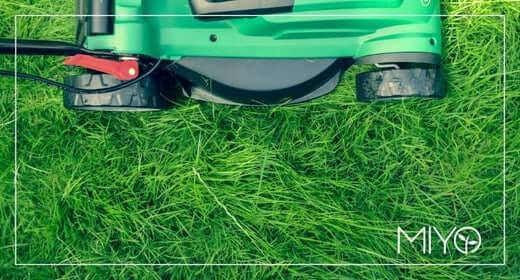
A beautiful lawn needs good care so that no yellow or brown spots form on the green carpet. We have summarized for you which to-dos are necessary for proper lawn care and which mistakes should be avoided:
Proper Mowing
Lots of sun stimulates the lawn to grow. At the beginning of the warm season, it grows especially fast. By regularly trimming, the lawn forms fresh side shoots and the green area gains density and resilience. But beware: grass blades cut too short cause the soil to dry out faster and weeds can spread.
As a rule of thumb for cutting height:
- Ornamental lawn should be cut to 3-4 cm,
- Play and sports lawn at 3-5 cm,
- Shade lawn 5-7 cm,
- Herb lawn and flower meadow are taller and mowed only rarely.
Mow young lawn for the first time when it is 10 cm high.
Ideally, you should take out the lawn mower once a week and mow the entire green area. If the grass has grown a bit taller during vacation, please mow it down to normal height gradually. In summer, lawn care should mainly focus on protecting the lawn from drying out or extreme heat. At very high temperatures, the blades should be allowed to grow a bit taller, as this reduces evaporation. This way, the grass maintains a better water balance and burns can be prevented.
Proper Watering
How often should the lawn be watered
The basic rule is: water less often (1-2 times per week), but more deeply. This stimulates root growth and forces the lawn to root deeper. Daily watering can harm the lawn.
- The very best time for watering is early in the morning. In direct sunlight, the lawn firstly cannot absorb moisture well and secondly the water evaporates very quickly and cannot reach the roots. This can result in unsightly yellow spots.
But in the evening the soil is also cool, so more water can be absorbed and less evaporates. Additionally, the greenery is protected from burning because the sensitive blades are not damaged by the burning glass effect of water droplets, and the moisture can distribute well in the soil overnight. - Grass should not be constantly wet, as it then becomes more susceptible to diseases.
The right amount of water for lawns
The required amount of water for the lawn varies throughout the year and depends on temperature, wind, natural precipitation, location of the lawn area, and the growth phase of the lawn. The water loss from a surface to the atmosphere is called evapotranspiration. There are calculation models to estimate this, which approximate the sum of soil evaporation and release by plants (transpiration). See the dedicated blog post at MIYO for more.
Approximate water demand over the course of the year in Central Europe:
Spring: 15-30 mm per week (equivalent to 15-30 liters/m²)
Summer: 30-50 mm per week (equivalent to 30-60 liters/m²)
Autumn: 10-20 mm per week (equivalent to 10-20 liters/m²)
Winter: 0-5 mm per week
The current evapotranspiration values are continuously calculated by MIYO for the garden location and displayed in the MIYO app.
Due to the large fluctuations in water demand, optimal irrigation requires constant adjustment of the watering amount and monitoring of soil moisture. And that is exactly what MIYO does. The sensors measure the soil moisture and MIYO optimizes the water amount fully automatically, taking into account measurements, presets, demand, and weather forecast. Additionally, soil moisture is also monitored. If the water has sufficiently penetrated deep, the irrigation switches off again. Optimal lawn care can be that simple.
Proper Fertilizing
Efficient lawn care in summer includes proper fertilizing in addition to mowing and watering. In the hot season, the nutrients from the spring fertilizer are usually used up. The lawn should now be supported with a long-term lawn fertilizer specially formulated for summer. This also makes it more resilient, and the fertilizer helps it regulate its water balance. For compact and acidic soils, lime and humic acids should also be spread.
Quality is also crucial! Cheap fertilizers only stimulate growth temporarily and provide the grass with too few nutrients in the long term. By the way, the ideal time to fertilize is a dull morning that still promises rain. If that is not possible, the evening should be chosen as the time and then watered thoroughly.
We wish you much joy with the well-maintained lawn in your garden paradise.



Leave a comment
All comments are moderated before being published.
This site is protected by hCaptcha and the hCaptcha Privacy Policy and Terms of Service apply.