This is how soil moisture measurement works
Water - a special substance
Water is the most common and a very special chemical compound on Earth. 70% of the Earth's surface is covered by water, and the human body also consists of 60% water. 97% of the water is in the oceans, and only 0.001% is in clouds, air, and precipitation. However, since atmospheric water cycles 37 times per year, an enormous 1 m of precipitation falls worldwide on average each year.
Water is the basis of all life on Earth, and since ancient times, humans have been engaged with technologies to utilize water.
Gravimetric and volumetric soil moisture
When dealing with soil moisture measurement, the question of the measurement parameter quickly arises. Soil moisture can be determined both by the volume fraction and by the weight fraction of water.
The volumetric moisture (θᵥ) is defined as the volume of water divided by the total soil volume.
Example:
1 liter of garden soil with 400 ml of water in it → θᵥ = 0.4 or 40%
The gravimetric moisture (θg) is defined as the ratio of the mass of water to the total mass.
Example:
1 liter of the garden soil from the above example weighs dry, for example, 1,200 g. If 400 g of water is added, the total weight is 1,600 g and θg=400/1,600=25%
That means one liter of the same garden soil with 400 ml of water has a volumetric moisture of 40%, but a gravimetric moisture of 25%.
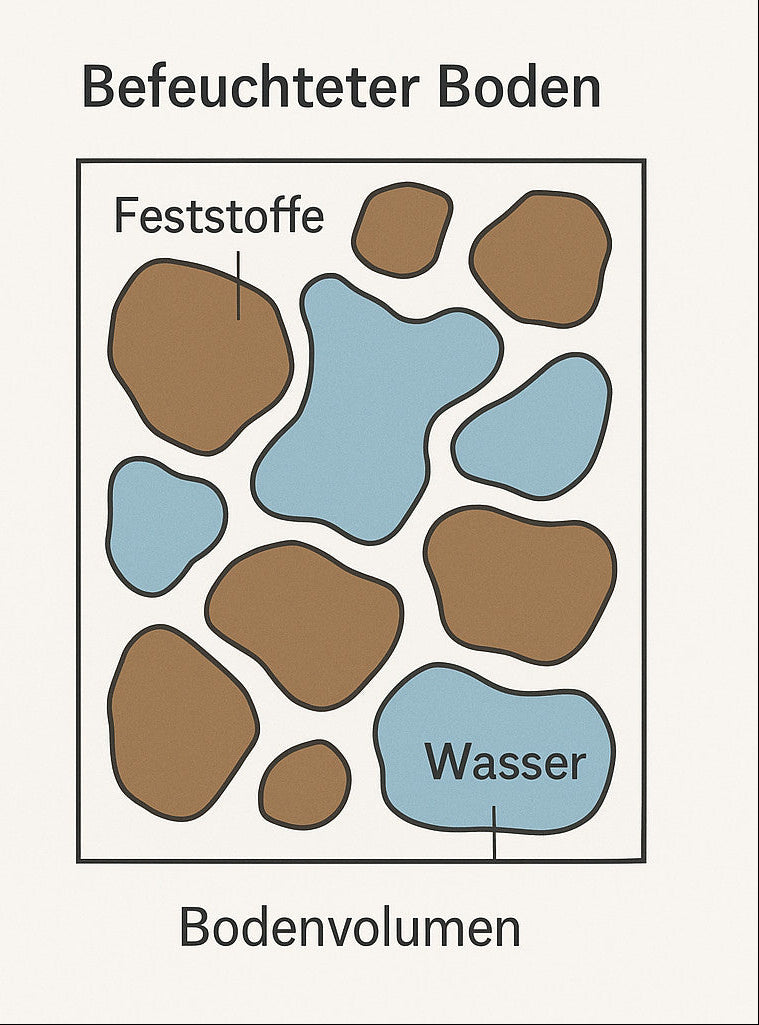
Over a wide moisture range, the soil volume remains largely constant because water fills pores and gaps. Only when a lot of water has disappeared and the soil structure collapses does the volume decrease. Then, drying cracks become visible. When and to what extent this occurs depends heavily on the soil type. In sandy soils, the volume changes hardly at all even in a completely dry state because the particles are so large. Therefore, volumetric and gravimetric moisture also change very differently.
Continuation of example: if another 100 ml of water is added, the volumetric moisture increases from 40% to 50%. The gravimetric moisture is now 500/1,700=approx. 30%, so it has only increased by 5 percentage points. The numerical difference between the volumetric and gravimetric measurements of the same soil sample can therefore be considerable.
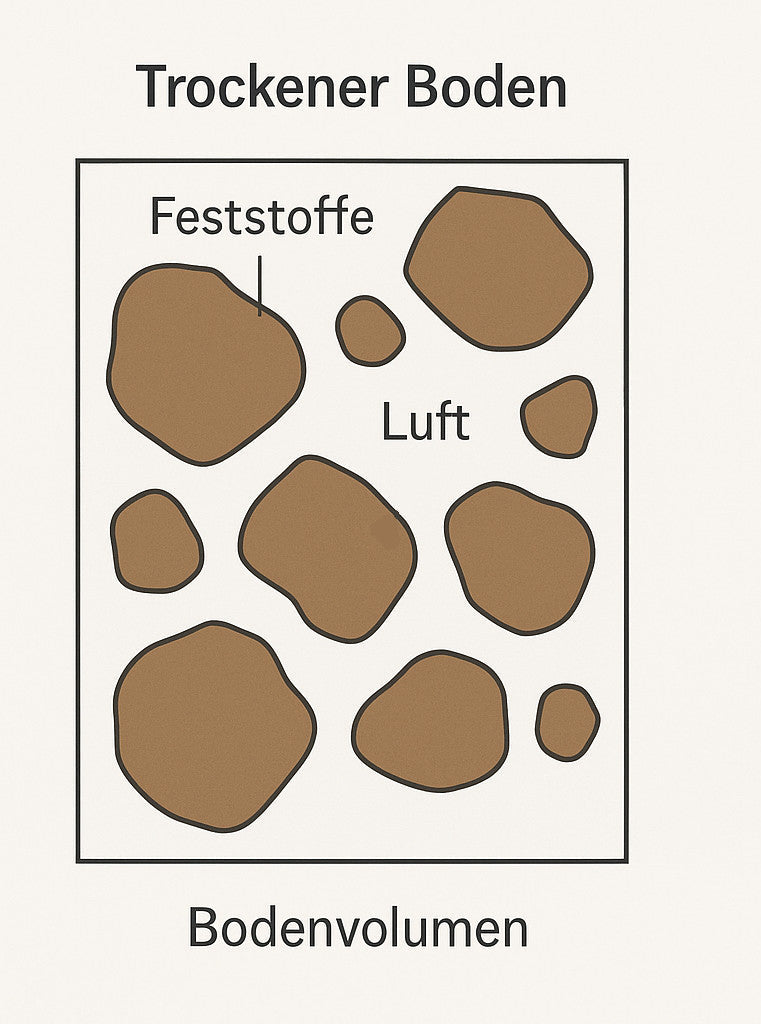
The following images schematically show how water fills the free spaces in the soil without significantly changing the total volume of the soil.
Measurement methods for soil moisture
1. Gravimetry (Weight Determination)
The method is simple and accurate, but still laborious. You only need a scale, a heat-resistant container (at least 1/2 liter), garden tools, and patience.
Procedure: Weigh the container, fill the soil sample into the container and weigh. Then dry the soil sample, e.g. in the sun (2-3 days) or in the oven (2-3 hours at 110°) or in the microwave. Determine the weight after drying.
The measurement is interesting to determine soil properties such as field capacity once, but for continuous practical use in the garden it is far too laborious and time-consuming.
2. Resistive Soil Moisture Measurement
Resistive soil moisture sensors measure the electrical resistance between two electrodes and thus how well the environment conducts electric current. The problem is that pure water is a very poor conductor. Only the dissolved salts in the soil make water conductive. The measurement correlates somewhat with the amount of water in a specific garden, but is extremely soil-dependent. The measurement says much more about the amount of dissolved minerals and salts in the solution than about the absolute water content.
Small currents also flow, which increases energy consumption and damages the electrodes in the long term due to deposits. To a small extent, metals are also released into the soil.
Overall, resistive soil moisture measurement has many weaknesses and is only conditionally recommended.
3. Capacitive soil moisture measurement
For understanding capacitive measurement methods, a brief excursion into the chemistry of water is necessary.
Water molecules are small and consist of one oxygen atom and two hydrogen atoms. The electrons of the molecule are strongly attracted by the oxygen atom. Therefore, the molecule has a negatively charged region around the oxygen atom and a positively charged region around the hydrogen atoms when viewed from the outside. Water is thus the prime example of an electric dipole. The dipole moment of water is responsible for many of its unique and vital properties, such as:
- Its ability to act as a solvent to dissolve other polar substances and salts.
- The formation of a crystal-like structure, which leads to its high boiling point, surface tension, and capillary action.
When water molecules are brought into an electrically charged environment, such as between a positively and a negatively charged plate (electrodes), they align opposite to the plate charge. This dampens the charge and requires energy. This is shown in the following diagram:
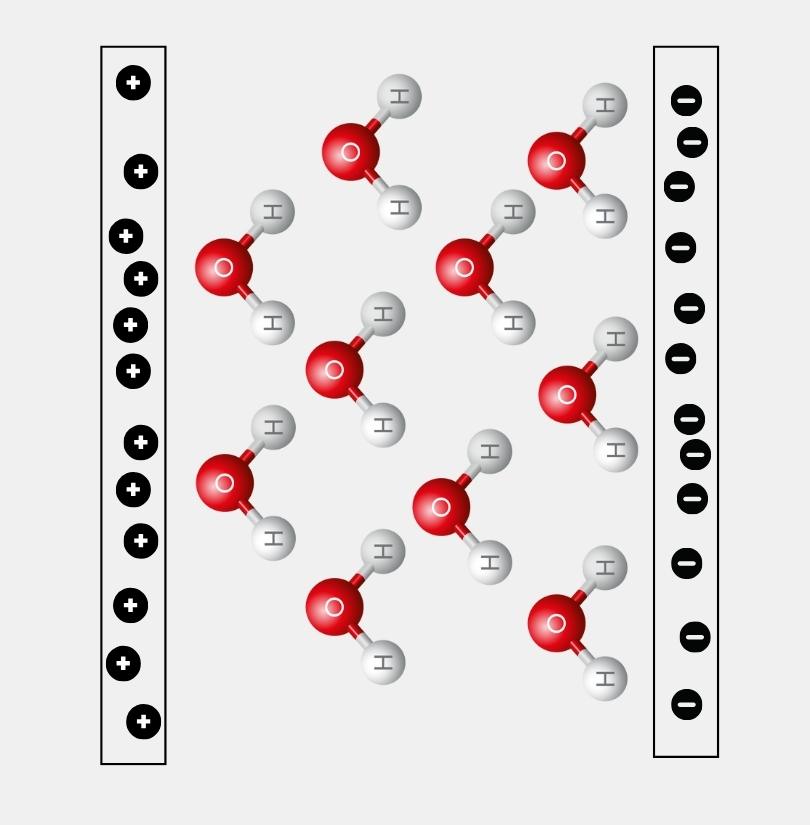
The property of charge storage is material-specific and is called permittivity, measured by the permittivity number. For water, this is 80 and is significantly higher than for most other substances. For comparison, the permittivity number of air is 1 and that of dry soil ranges between 3 and 10. Thus, water stores charge to a very small extent like a battery. Of course, water cannot be used as a battery, but the effects resulting from permittivity can be measured by numerous methods. These effects include signal delay, amplitude attenuation, reflections, and others. Capacitive measurement methods are based on these. There are many possibilities for the specific technical design, which are divided into 2 groups.
3.1 Time Domain Reflectometry
Sensors of the first group send a short signal pulse and measure the travel times of the signal or reflections. This requires highly precise time measurements. The English term TDR (Time Domain Reflectometry) is generally used. TDR sensors are usually large, offer good measurement accuracy, are complex to install, must be calibrated for the soil, and are expensive.
3.2 Frequency Domain Reflectometry
The second group of capacitive sensors uses a high-frequency signal and measures frequency changes upon contact with the soil sample. The most commonly used English term is FDR (Frequency Domain Reflectometry). FDR sensors offer good accuracy, have less complex electronics, and are easier to handle than TDR, require calibration to the soil for best results, and are more cost-effective than TDR.
Practical tips for capacitive sensors
Volumetric measurement: capacitive Sensoren measure the electrical capacity and permittivity of the surrounding soil.
This closely correlates with the volumetric water content, i.e. the ratio of water volume to total volume. The Sensoren "see" the entire electric field – that is air, water, and solids – as a mixture. Therefore, all measurement results are also soil-dependent. For example, salts, fertilizers, and humus increase the base capacity of dry soil. Heavy soils also have a higher base capacity. This means that without calibration, there can be no absolutely correct moisture measurement because the influence of the soil is not negligible.
Calibration: all capacitive Sensoren would have to be calibrated to the soil if one wants to obtain correct absolute volumetric moisture values. In practice, however, this is usually not necessary because the measurement values of a Sensor are constantly shifted "by the soil factor." This must only be taken into account when interpreting the results and especially in irrigation control.
Penetration depth and measurement range of capacitive Sensoren are limited to the area between the electrodes. That means if you want to perform large-volume measurements, the Sensoren quickly become large and unwieldy. The spatial extent is very small, as areas a few centimeters away from the probe no longer contribute significantly.
Soil contact: for reliable measurements, the Sensor surface needs contact with the soil.
Influence by Sensor: the installation of the Sensor also changes the water flow in the soil. The larger the Sensor, the greater the effect.
Temperature dependence: The permittivity of water is temperature-dependent – for example, it is about 80 at 20 °C, rises to about 88 at 0 °C, and drops to about 72 at 40 °C. This means warmer soils appear drier. This effect is independent of temperature influences on the electronics and affects measurement accuracy.
The MIYO technology
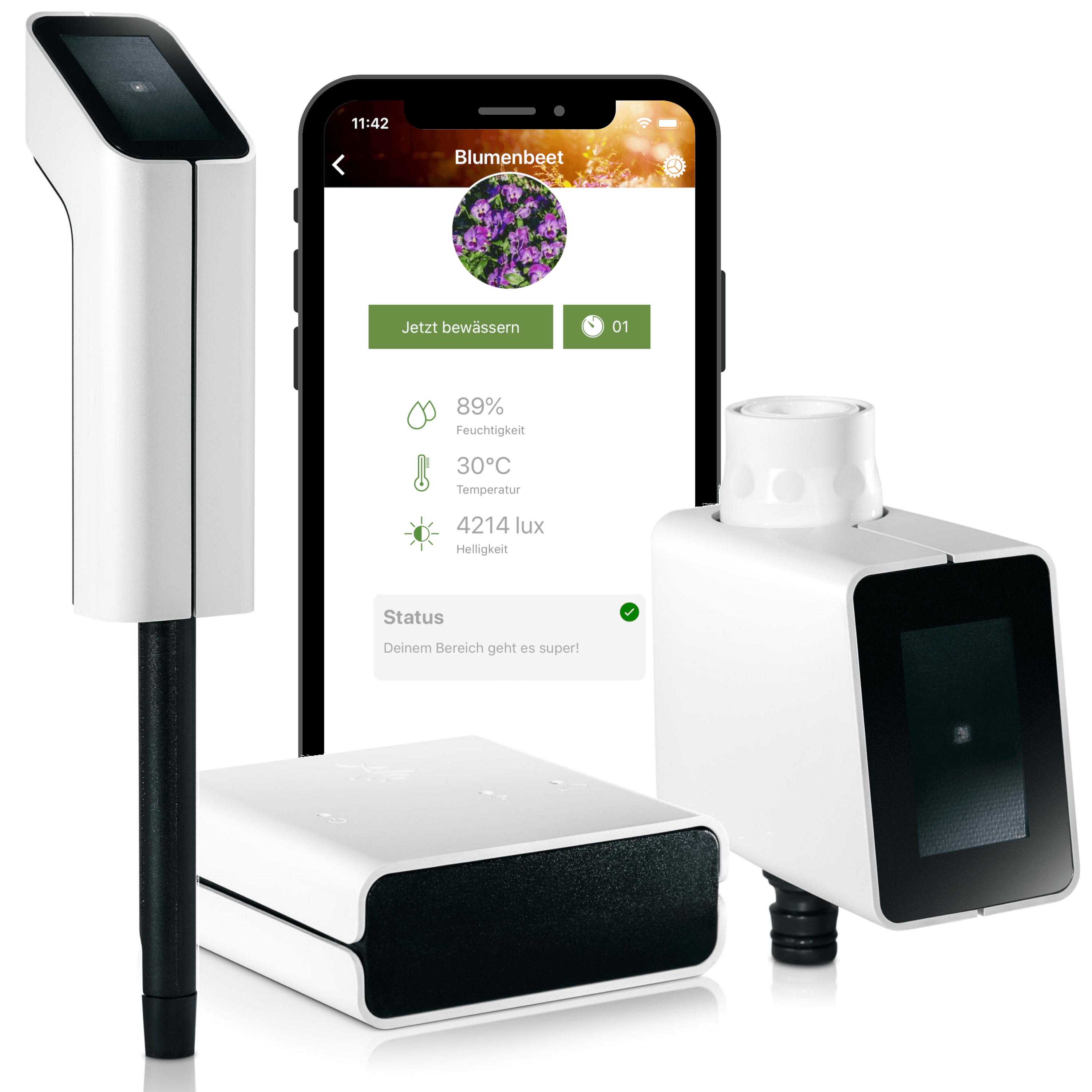
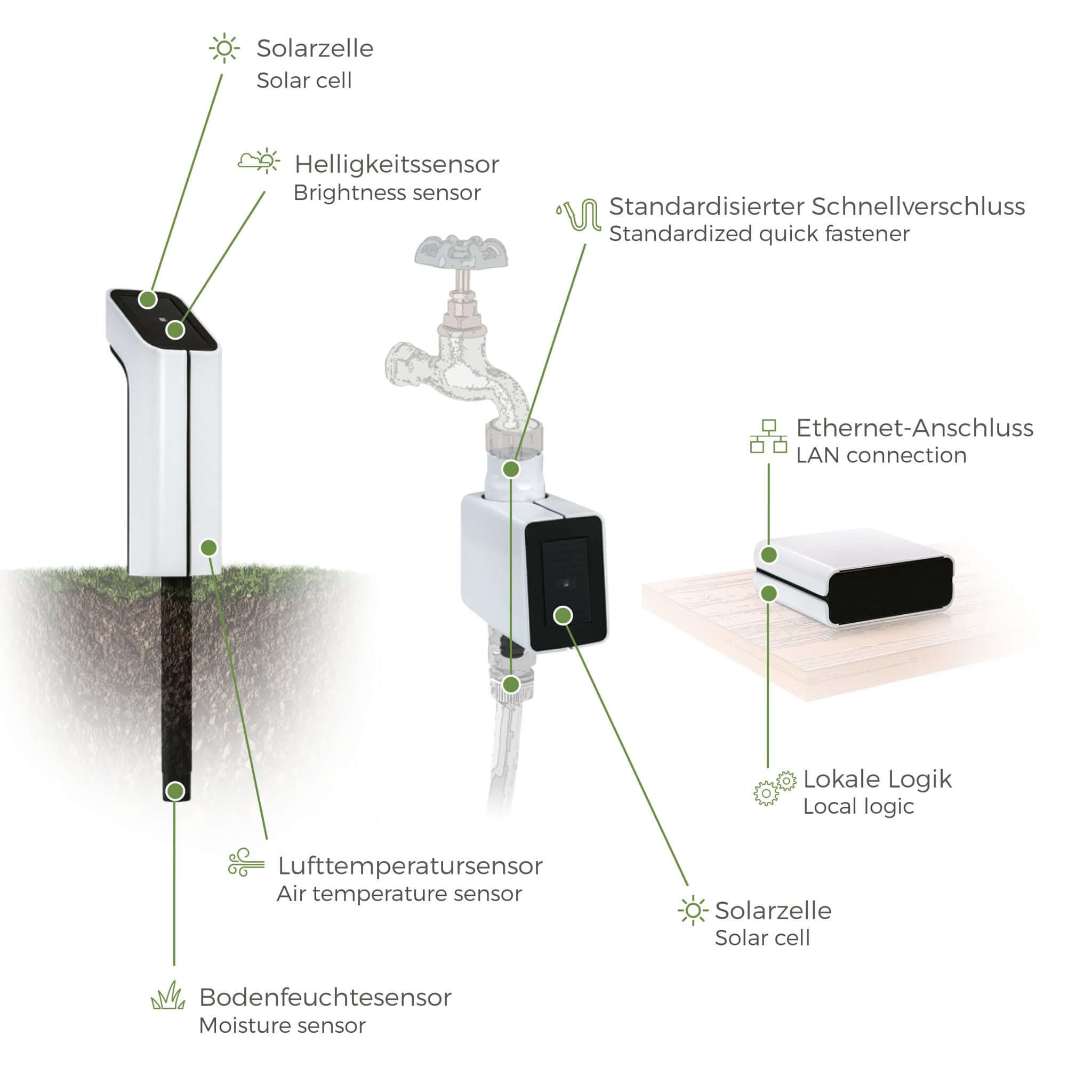
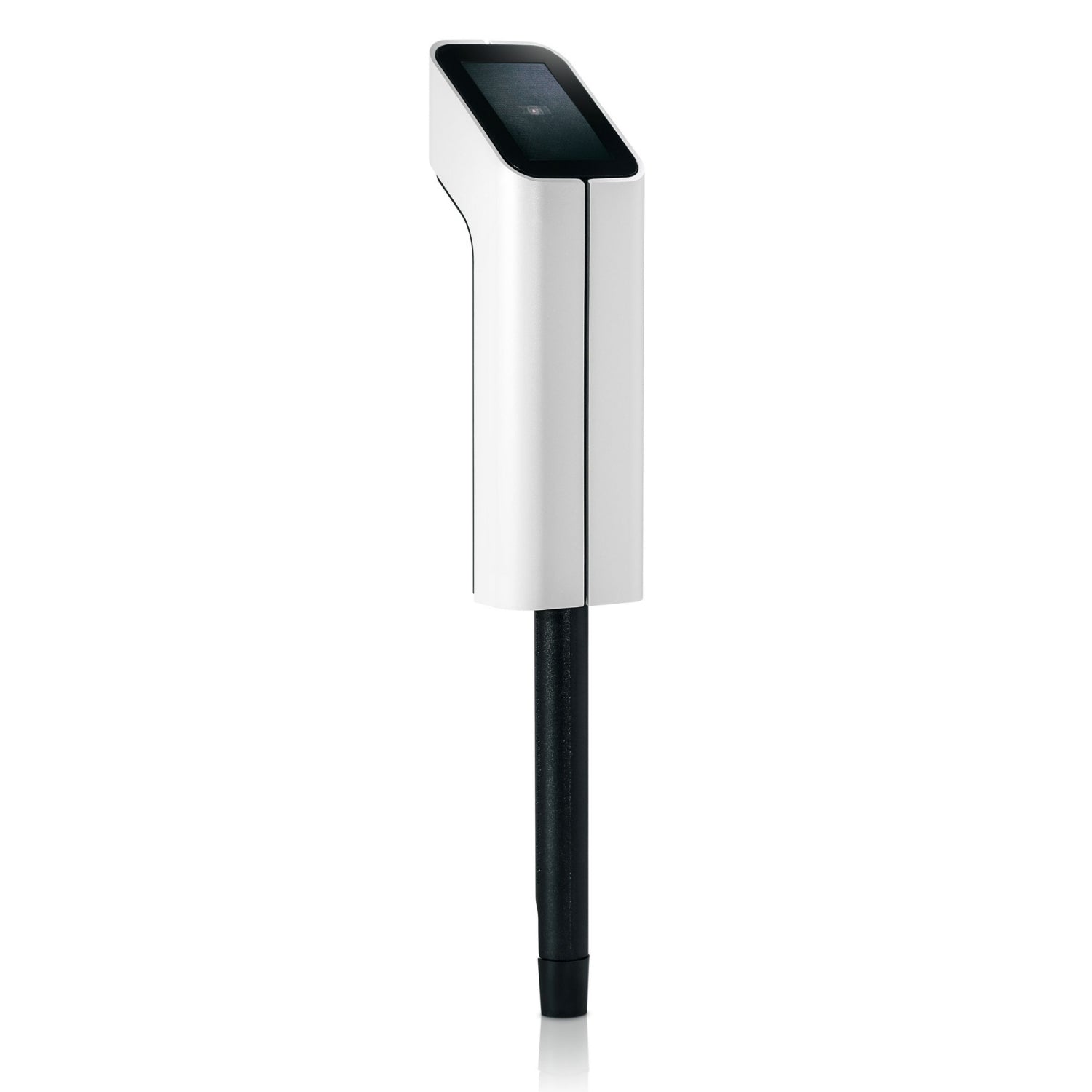
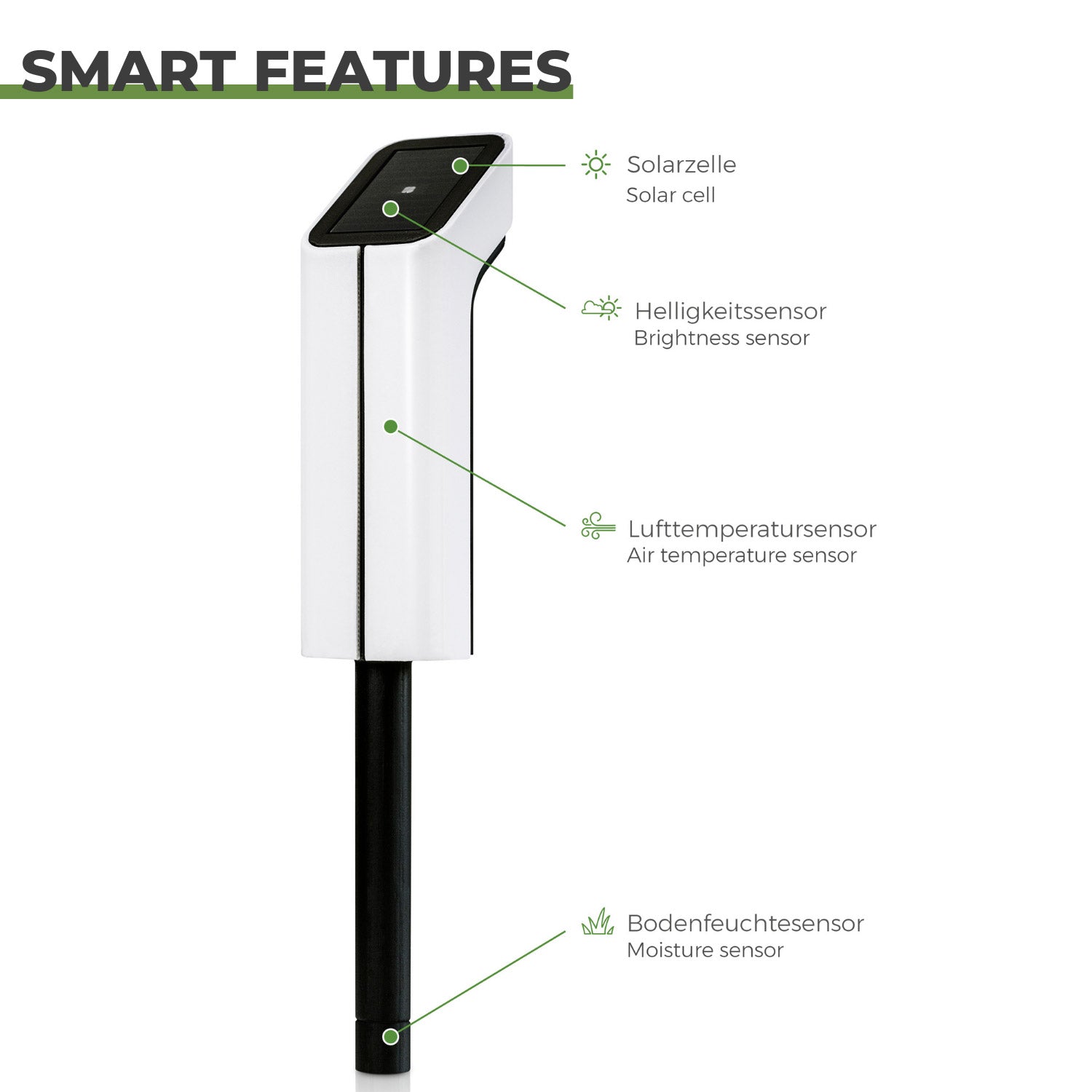
The MIYO Sensors use a proprietary FDR technology for soil moisture measurement. No fixed frequency is generated; instead, an oscillating circuit is only excited. The soil is part of the oscillating circuit and depending on the surrounding capacitance, a frequency is established that is measured. A measurement takes 30 milliseconds, and the lower the frequency, the more moisture is in the soil.
Crucial for measurement accuracy is the correct installation. The Sensor surface at the base needs soil contact, but not with excessive pressure, as otherwise the measured values will be too high.
Here's how to proceed:
Dig a hole at least 13 cm deep. If needed, it is also no problem to bury the Sensor deeper. The top 3 cm should definitely protrude from the soil, as the antenna is located there. Remove coarse impurities like wood or stones and loosely sprinkle a handful of soil into the dug hole. Insert the Sensor. The Sensor surface should have soil contact without excessive pressure. Refill the hole and compact the soil. Water the hole so the soil further solidifies. Done. In the app, you can already see the current soil moisture.
Our customers say it better than we do!
Based on 29 reviews
You might also like this